
Effects & training goals
Muscle loss with age: what role can EMS play?
Getting up from a chair, climbing stairs or carrying shopping: muscle strength helps you stay active in everyday life. As you get older, muscle mass and strength can decline. Regular strength training addresses this, and whole-body EMS can be a time-saving addition.
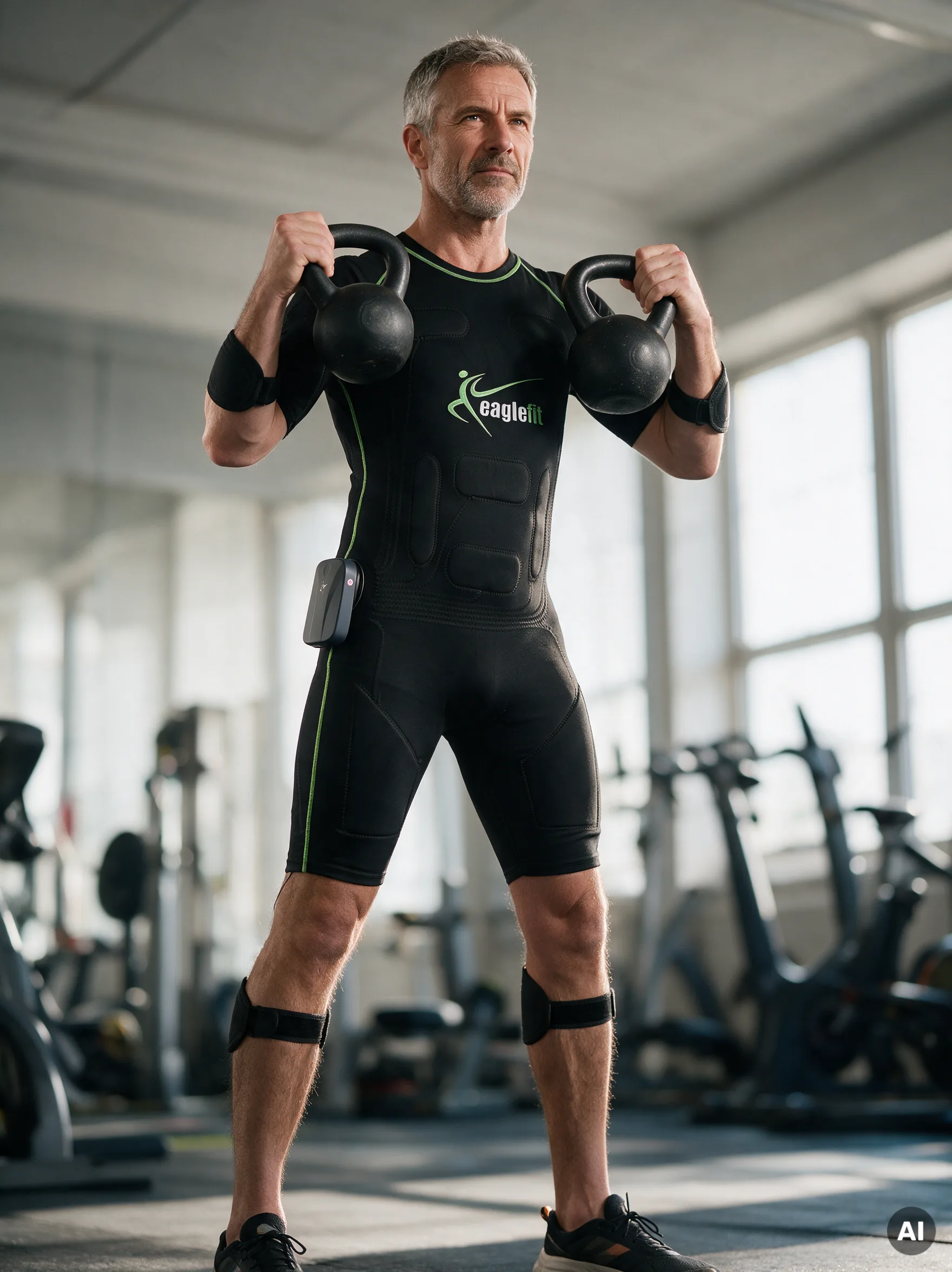
Understanding muscle loss and sarcopenia
Muscles change as we age. If there is a marked loss of muscle mass and muscle function, sarcopenia may be present. Declining strength alone is not yet a diagnosis. If everyday movements become increasingly difficult for you, have the cause checked by a doctor.
Strength training remains the foundation
Regular training against resistance helps maintain muscle strength and muscle mass. This can be done with your own body weight, bands or weights. Suitable exercises, controlled movements and a load that matches your abilities matter more than heavy weights.
What the TEST-III study shows
76 slim, physically inactive women with an average age of 75 were randomly assigned to an EMS group and a comparison group. After around one year, the whole-body EMS group showed better results for muscle mass and for leg extension and trunk strength than the group with a less extensive exercise programme. You can find the detailed results and the link to the original paper in the studies guide.
More recent results: more strength and everyday performance
A randomised study by Centorbi and his research team in 2024 examined 61 older adults with an average age of 71. Over twelve weeks, they compared endurance training with and without additional whole-body EMS. The EMS group trained twice a week for 20 minutes.
The group with EMS achieved better results in several strength and function tests than the endurance group without EMS. Advantages were seen in repeated arm curls, grip strength, rising from a chair and the six-minute walk test. The results thus show the potential of EMS to support not only muscle strength but also physical performance in later life. You can find the detailed results and the link to the original paper in the studies guide.
What this means for EMS at home
The studies show what is possible under controlled conditions; they are no guarantee for every training programme. For the whole body, an EMS suit is suitable; PANTS, vest or Belt train specific areas.
Start carefully
Before you start, check whether EMS suits your health. If you have an illness, after surgery or if you are unsure, a medical check is part of it. Start with one session a week, a low intensity and exercises you can do safely.
A goal that fits your everyday life
Set yourself concrete goals such as getting up more easily or having more strength when carrying things, and plan enough recovery. What matters is training you can do regularly – with or without EMS.